

Heavy-duty transportation: the electric revolution is underway

Optimise the Value Created by Your Innovation.
Developing proprietary technology, software, processes and know-how can create significant long-term value. But capturing that value requires more than protecting intellectual property: it requires the right financial, tax and organisational strategy.
ABGi helps businesses connect their R&D investment, intellectual property and innovation income to build a more effective and sustainable value strategy.
R&D tax credits reduce the cost of innovation investment (input side). IP box regimes reduce tax on the profits generated by innovation (output side).
The core mechanism is a bifurcated tax treatment: income attributable to qualifying IP is separated from other income and taxed at a preferential rate (which can be as low as 4% in some jurisdictions, versus a standard corporate rate of 20–30%).
Identify
Map your Qualifying IP.
Identify the patents, software, know-how and other IP assets that may qualify under the applicable regime.
Quantify
Determine your Qualifying Income.
The value of an IP Box benefit is directly linked to the R&D investment behind the IP. The more clearly you can demonstrate the connection between qualifying R&D expenditure and IP income, the stronger your Nexus position.

IP regimes vary significantly across jurisdictions, from the assets and income that qualify to the applicable tax rate and Nexus requirements. ABGi combines global insight with local expertise to help businesses identify the right opportunities across markets.
34 %
Brazil
No federal IP Box regime. IP income is taxed at the standard corporate income tax rate.
26.5 %
Canada
No federal IP Box regime. IP income is generally taxed at the standard corporate income tax rate.
10 %
France
Patents, patentable inventions, plant varieties.
30 %
Germany
No IP Box regime. Standard corporate taxation applies.
6.25 %
Ireland
Patents, copyrighted software, oral/written information.
5 %
Poland
Patents, software, R&D results.
10 %
21 %
USA
No federal IP Box regime. Standard corporate tax applies.
Indicative rates only. Eligibility, qualifying assets, income and effective rates vary by jurisdiction and company profile.
Eligibility is defined along two axes: the nature of the IP asset, and the type of income it generates. Both must qualify for the regime to apply.
Companies that generate revenue from products incorporating qualifying IP may also benefit from IP Box regimes, where the contribution of that IP to product income can be demonstrated and quantified.
IP box regimes deliver maximum value when integrated with R&D tax credits and, where applicable, direct grant funding. The three instruments address different stages of the innovation lifecycle and interact in ways that require careful coordination.
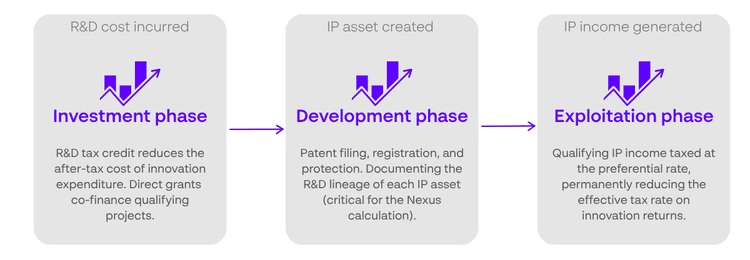
ABGi helps you coordinate these instruments across the innovation lifecycle: from R&D investment to IP income, while managing the technical, financial and tax requirements behind each one.
Let’s explore how your R&D, intellectual property and innovation income could work together to create greater long-term value.
Do we need a granted patent to benefit from an IP box regime?
Can a company benefit from an IP box in a country where it does not manufacture or sell its products?
How does the Nexus Approach affect companies that outsource part of their R&D?
Can IP box income be combined with R&D tax credits in the same jurisdiction?


Heavy-duty transportation: the electric revolution is underway

Agroecological transition – Challenges and prospects for agricultural machinery manufacturers, seed companies and agrochemicals firms
