
Heavy-duty transportation: the electric revolution is underway

Reduce Tax on Innovation Income with IP Box Regimes.
An IP Box, also known as a patent box, innovation box, or knowledge development box, is a preferential corporate tax regime that applies a reduced tax rate to profits derived from qualifying intellectual property assets. Rather than taxing all corporate income at the standard rate, IP Box countries ring-fence innovation income and subject it to a substantially lower effective rate.
The economic logic is straightforward: by reducing the tax burden on returns from innovation, governments incentivise companies to locate their IP development activities within their jurisdiction, and to retain rather than offshore their IP assets.
For companies that develop proprietary technology, software, processes, or branded know-how, IP Box regimes offer a permanent, structural reduction in the effective tax rate on a significant portion of their income.
IP Box vs. R&D tax credit: key difference
R&D tax credits reduce the cost of innovation investment (input side). IP box regimes reduce tax on the profits generated by innovation (output side). They are complementary, and many companies benefit from both simultaneously. ABGi advises on optimising both instruments together.
The core mechanism is a bifurcated tax treatment: income attributable to qualifying IP is separated from other income and taxed at a preferential rate (which can be as low as 4% in some jurisdictions, versus a standard corporate rate of 20–30%).
02. Calculate qualifying income
Identify qualifying IP assets
Calculate qualifying income
Apply the Nexus fraction
Tax qualifying profit at preferential rate
More than 20 countries operate OECD-compliant IP box regimes. The effective rates and scope of qualifying IP and income vary materially.
34 %
Brazil
No federal IP Box regime. IP income is taxed at the standard corporate income tax rate.
26.5 %
Canada
No federal IP Box regime. IP income is generally taxed at the standard corporate income tax rate.
10 %
France
Patents, patentable inventions, plant varieties.
30 %
Germany
No IP Box regime. Standard corporate taxation applies.
6.25 %
Ireland
Patents, copyrighted software, oral/written information.
5 %
Poland
Patents, software, R&D results.
10 %
21 %
USA
No federal IP Box regime. Standard corporate tax applies.
Eligibility is defined along two axes: the nature of the IP asset, and the type of income it generates. Both must qualify for the regime to apply.
Granted patents
Pending patent applications
Utility models
Copyrighted software
Trade secrets & know-how (selected regimes)
Plant variety rights
Supplementary protection certificates
Exclusive licences
Royalties received
Embedded IP income in product sales
Licence fees
Damages for IP infringement
Capital gains on IP disposal (some regimes)
Milestone & sub-licence payments
Key insight for manufacturers and product companies: Even companies that do not license their IP externally may benefit significantly from IP box regimes through the embedded income mechanism — provided they can demonstrate and quantify the contribution of qualifying IP to their product margins. This is frequently the highest-value IP box opportunity for industrial groups.
IP box regimes deliver maximum value when integrated with R&D tax credits and, where applicable, direct grant funding. The three instruments address different stages of the innovation lifecycle and interact in ways that require careful coordination.
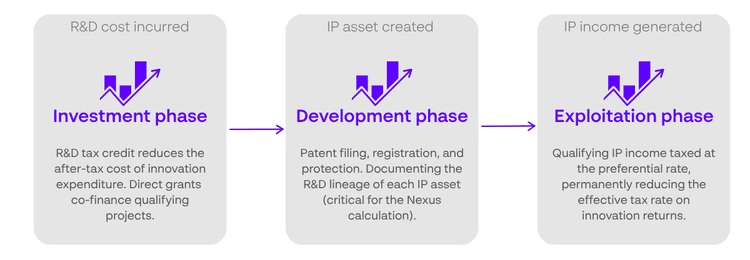 The Nexus Approach creates a direct link between the R&D expenditure phase and the IP box entitlement: every euro of qualifying R&D expenditure documented today improves the Nexus fraction, and therefore the share of future IP income that benefits from the preferential rate. This connection makes early, systematic R&D documentation both a compliance requirement and a long-term value creation lever.
Do we need a granted patent to benefit from an IP box regime?
Can a company benefit from an IP box in a country where it does not manufacture or sell its products?
How does the Nexus Approach affect companies that outsource part of their R&D?
Can IP box income be combined with R&D tax credits in the same jurisdiction?


Heavy-duty transportation: the electric revolution is underway

Agroecological transition – Challenges and prospects for agricultural machinery manufacturers, seed companies and agrochemicals firms
